
Smart Antennas Take Aim at 3G
By Janine Sullivan , Contributing Editor
3G Challenges
Range and Coverage
Increased Data Throughput
3G Migration
What's Next
Increased demands of third-generation (3G) wireless communications systems, including longer range, better coverage, and greater data throughput, will increase traffic on the wireless highway. Smart antennas -- antennas plus processing circuitry -- can reduce interference in these systems to improve range, coverage, and throughput—often without large changes to existing infrastructure.
3G Challenges
Envisioned applications for 3G systems are Internet access, web browsing, and multimedia applications such as videoconferencing and audio with full-motion video. Next-generation systems also should address the limitations of existing second-generation (2G) systems, primarily throughput, roaming, coverage, and capacity, while at the same time expanding from voice-only systems to voice plus data systems.
With the deployment of 3G, existing cellular networks will face challenges for range and capacity that will be based on the increased number of subscribers and the accompanying increased interference with the communication signal, according to Frank Viquez, Analyst at Allied Business Intelligence, Inc. (Oyster Bay, NY). "Smart antenna systems would significantly cut the amount of inherent interference in existing wireless networks," says Viquez, "so it will be vital for smart antenna technology to be employed to improve network range and capacity."
Along with reducing interference, smart antennas can make adjustments based on range and coverage.
Range and Coverage
When challenged with many users in a specific area, the smart antenna reallocates bandwidth to increase range. Wireless Online (Los Altos, CA) reports that its prototype network of smart-antenna receivers using its proprietary Spacial-Division-Multiple-Access (SDMA) technology delivered independently-confirmed range increases of 250% over the company's existing two-way messaging technologies.
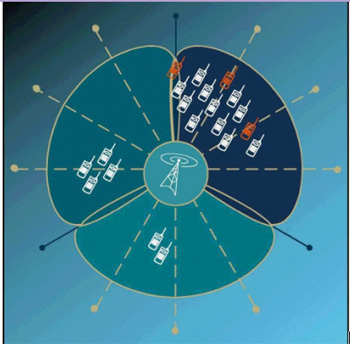
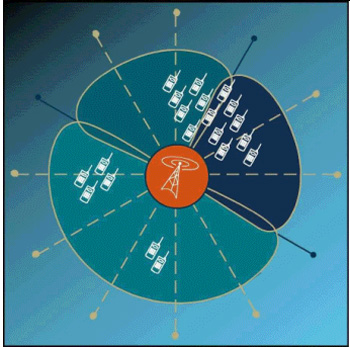
When faced with many users in a cell, the smart antenna redistributes bandwidth to increase coverage (see Figure). For example, in the first commercial deployment of its SpotLight 2000 CDMA smart antenna system in a six-sector cell, Metawave Communications Corp. (Redmond, WA) reports that its system delivered a capacity improvement of 74% over the original three-sector baseline configuration.
Increased Data Throughput
Adding the 3G data requirements of up to 2 Mb/s to existing systems translates to substantially increased traffic in a limited bandwidth, but smart antennas can help meet these demands. "Smart antennas reduce interference which allows higher data rates over a larger area of the network," explains Lowell Anderson, Director of Product Management at Metawave. The company's SpotLight system is designed to reduce interference for Code Division Multiple Access (CDMA) networks using proprietary Sector Synthesis technology, which balances traffic and tunes the cell's coverage pattern. For Global System for Mobile Communications (GSM) systems, the antenna employs narrow beams aimed directly at the mobile receiver.
3G Migration
"The SpotLight smart antenna system not only works with the current CDMA and GSM interfaces, but was designed to operate with 2.5G and 3G standards," says Anderson. So, the company will use this product to support 3G systems as they are deployed.
Wireless Online plans to migrate its SDMA technology to 3G using a scalable modular product line. "In addition," says Angela Hey, Acting Vice President of Marketing, "there are alternative networks that could carry data for 3G including two-way mobile messaging systems for short messages or mutlichannel multipoint distribution service
(MMDS) technology for desktops and local area networks (LANs)."
What's Next
Since Metawave already has antennas in the field, it sees the next step for smart antenna technology as widespread deployment. "Smart antennas provide a cost-effective way to improve the coverage and capacity of existing networks to prepare for migration to 2.5G and 3G applications," explains Anderson.
One of the issues facing smart antennas into the future is flexibility. "Unlike a PC, base stations do not have open architectures," reports Hey, "and this is the most significant hurdle that manufactures have to overcome as additional hardware is built into the antenna."
"A truly adaptive smart-antenna system would be preferred for 3G," concludes Viquez, "because the narrower beams would further improve the significant coverage and capacity gains of smart antennas, but adaptive technology would require a method of pinpointing the handset."
According to industry experts, as global deployments of 3G systems begin, smart antenna technology is likely to be a key factor in their levels of success.
About the author…
Janine Sullivan is a contributing writer for Wireless Design Online. She is also the former editor of Communications Products magazine and the founder and owner of The Write Solution, a technical writing agency. Janine can be reached at The Write Solution, write@interactive.net.
Allied Business Intelligence (ABI) recently issued a report "Wireless Antenna Markets 2000." For more information, contact ABI at 516-624-3113.