
Tutorial on Antenna Feedline System Testing—Part 1
By Christie Brown, Hewlett-Packard (HP)
Contents
An Overview
The Overall Antenna System
Common Sources of Failure
Testing Solves The Problem
Maintenance Testing
Time/Frequency Domain Measurements
Transmission Line Measurements
About the Author
Cellular and PCS service providers are faced with many different challenges. The desire to increase capacity and expand coverage in order to increase the subscriber base, the increasingly stringent specifications for digital versus analog systems, and the need to keep costs down, are just some of the issues service providers must deal with when installing new cell sites and maintaining existing infrastructure.
Increased user capacity is important to existing service providers within densely populated urban areas. Dropped calls due to system capacity limitations create dissatisfied customers and can result in lost revenue due to churn. The need to establish and expand geographic coverage is especially critical to new PCS service providers as well as those cellular service providers that are expanding into rural areas.
This is part 1 in our two-part tutorial on antenna feedline system testing. In this part, I will provide you with an overview of an antenna feedline system and will provide an overview of the key tests engineers nee to perform during antenna system design and setup. In part 2, which will appear next month, I will give a more in depth look at return loss measurements as well as fault location detection. So, let's start part 1, with an overview of a typical base station antenna system.
An Overview
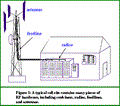
A typical cell site contains many pieces of RF hardware. These may include, but are not limited to, the racks of radios, combiners, coaxial feedline, tower-mounted amplifiers, lightning protection devices, filters, antennas, etc. (Figure 1).

Evaluating the quality of the RF components used in a cell site is of utmost importance in today's communication systems. For example, the attenuation of the transmission lines, along with the insertion loss of the combiner, determines the majority of loss that occurs in the transmitting portion of the antenna system. Any imperfections or damage to this feedline can severely impact transmission quality of the entire system.
The Overall Antenna System
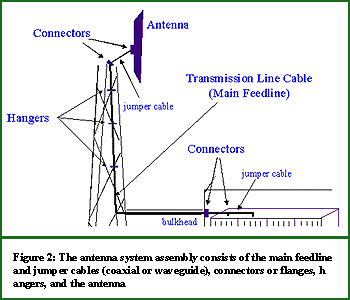
The antenna system assembly consists of the main feedline and jumper cables (coaxial or waveguide), connectors or flanges, hangers, and the antenna (Figure 2).
When evaluating or installing an antenna system, it is important to understand the effect the feedline assembly has on the entire system to help avoid intermittent problems and failures. Knowing performance parameters such as feedline loss is especially critical when operating in the 800 to 900 MHz and 1.8 to 2 GHz frequency ranges. At these frequencies, the wavelength is very short and suffers greater propagation attenuation than the longer wavelength signals of lower frequencies. Thus, the system performance, in terms of the power transferred from the transmitter to the antenna, and from the antenna to the receiver, is characterized by the antenna feedline.
Common Sources of Failure
Antenna feedline systems are typically the most common sources of failure in a communication system. The transmission lines are exposed to all sorts of weather conditions that cause damage by mechanical stress, lightning, moisture and corrosive atmospheres. Towers make good targets for vandals, since a very common cause of failure is created by bullet holes in the cables or antennas. Other common problems in the feedlines or antennas include discontinuities such as damaged junctions or support bends, and pinched cables caused by over-tightened hangers, or accidental denting by tower climbers.
The connectors used in feedline systems also present a great potential for problems, since moisture will invariably find its way inside. Normal atmospheric pressure changes will always equalize unless the system is deliberately pressurized. Low quality connectors, poor connector contact, corroded connectors, and improperly tightened or loose connectors are examples of critical fault conditions. Over time, these conditions can cause degradation or complete system failure.
Testing Solves The Problem
In wireless systems, antenna feedline problems can be hard to identify and, once found, are usually located high on a tower. With the right test equipment, identifying and isolating problems becomes very easy, and can be done at ground level.
At installation, it is necessary to do a complete set of tests on the antenna feedline system in order to fully characterize its initial performance. Measuring return loss is sometimes done several times; each time a component is added to the system. Once assembly is complete, tests such as insertion loss, feedline system return loss, fault location, and length are done. For characterization of the antenna, independent of the contributions made by the feed system, an important parameter is antenna return loss.
Another significant property of an antenna is the propagation characteristics that result in antenna patterns. While this is a separate topic that can be discussed extensively by itself, many of the measured properties of the overall antenna system are good indicators that the antenna pattern has been altered. Typically, this condition is confirmed from data collected by drive tests that define the cell site footprint.
Maintenance Testing
Routine maintenance allows early detection of problems, thus avoiding costly system shutdowns. However, when service must be interrupted, the outage can be minimized with rapid diagnostic procedures. The frequency with which routine maintenance is performed varies widely. But on average, it is done every six months. This is often done by the service provider, or may be contracted out to an independent group. Maintenance tests are typically limited to return loss and fault location, the two key indicators of the antenna feedline's integrity.
Each individual problem area on a feedline system is called a fault. Each transmission line fault, as well as the antenna itself, will reflect some of the transmitted power back toward the source (Figure 3). Measuring these reflections gives us a figure of merit for evaluating the quality of the transmission feed system, called reflection coefficient, return loss, or the standing wave ratio (SWR). The definitions of these, as well as other measurement techniques that allow us to gain further insight into the nature of the reflections, will be discussed in Part 2.
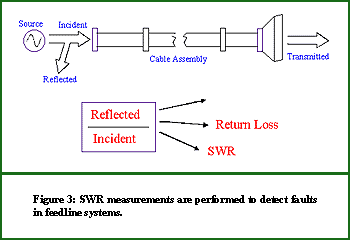
One way to test the antenna feedline system is to send a known, incident signal through it and measure the signals (traveling waves) that are reflected back. By measuring the amplitude ratios and phase differences between the incident and reflected waves, we can determine the reflection characteristics of the feedline system.
Time/Frequency Domain Measurements
In addition to SWR tests, engineers should also perform time and frequency domain measurements on antenna feedlines. These are essential tests in assuring the proper operation of a feedline system
Traditional frequency domain measurements are important for determining whether the system is working to specification. Measurements of power, insertion loss, return loss, etc. are used.
If the system is not meeting specs, then the problem arises as to how to measure where it has gone wrong. A time domain or fault location measurement provides such a tool. This information can be interpreted in terms of the physical layout of the system and can therefore identify which part of the system is not performing.
In addition to displaying the location of the different elements in the system, the time domain allows us to determine the impedance of these elements thus revealing their nature. For example, high impedance indicates an open fault such as caused by a hole in the cable or a loose connector, whereas low impedance indicates a short, such as a crimp or dented cable.
Transmission Line Measurements
When evaluating an antenna feedline system, it is also important to determine properly evaluate the transmission line cable. To do this, engineers should first start by evaluating the characteristic impedance of the product.
In general terms, the characteristic impedance of a cable is the ratio of the voltage to current of a signal traveling in one direction down the cable. The value of this impedance depends on factors such as the dielectric constant of the material and conductor diameters.
In a transmission line, the velocity of propagation, vp, is also an important parameter. This is simply the velocity of the electromagnetic waves inside the transmission media (transmission line) and is given by vp=kvc, where kv is the velocity factor and c is the speed of light in free space.
Another well-known cable measurement is insertion loss. Insertion loss requires that both ends of the cable are available, and measures the cable loss over the operating frequency range. This is an example of a transmission (rather than reflection) characteristic of the system under test. Rather than directly measuring the transmitted signal, a known high quality short can be put at the end of the cable. Knowing that this will reflect 100% of the signal, the measured return loss can simply be divided by 2 to get the system's insertion loss.
A final important measurement when evaluating transmission lines is cable length. Measuring the length of the cable gives you a baseline for that particular antenna system and allows you to verify that the subsequent return loss measurements are reasonable.
These four parameters, as well as operating frequency, are the basic characteristics that an operator must know about his/her antenna feedline system. These four measurements should be part of a service providers incoming inspection and installation procedures.
This concludes part 1 of this two-part tutorial on antenna feedline system testing. Part 2 of this set will take an in depth look at return loss measurements and fault location. Talk to you then!
About the Author:
Christie Brown is the training manager for the Microwave Instruments Division (MID) of Hewlett-Packard (HP). Prior to holding this position, she served as a Market Development Engineer working on various projects in the wireless communications market. She received her BSEE from San Jose State University in 1986, and her MBA/MS Engineering from the California Polytechnic University, San Luis Obispo, in 1993. Christie can be reached at christie_brown@hp.com.
Edited by Robert Keenan